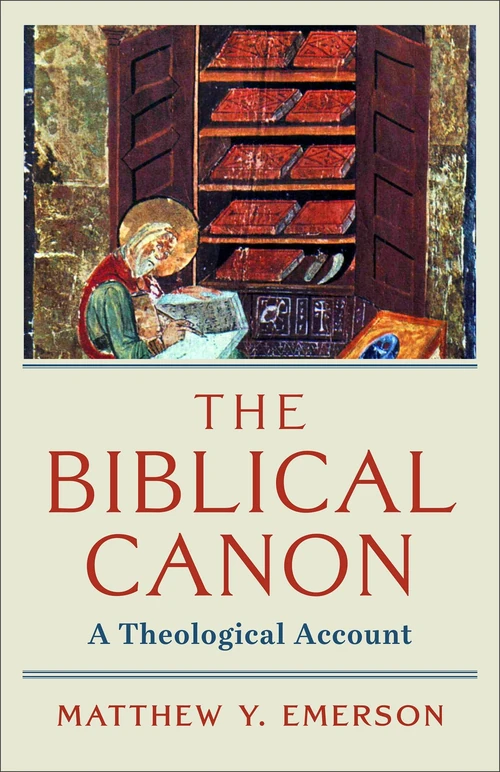
The Biblical Canon
- Theology
- Biblical Studies & Commentaries
- Publisher: Baker Academic (Baker Publishing Group)
- Published: 2026
FritzSearch.com earns a commission on purchases made through Bookshop.org links.
Publisher's Description
While most modern canon studies focus on the historical and empirical processes that produced Scripture's final form, this innovative work argues that the canon must be understood first as a theological reality. Far from being a merely historical artifact, the canon is a living witness that shapes, and is shaped by, the doctrines of the Christian faith. Matthew Emerson offers a fresh approach that situates the question of canon within its proper dogmatic context. Surveying the history of scholarship on the canon, he shows how prevailing approaches have overlooked the theological dimension of Scripture's unity and authority. By recovering this dimension, Emerson illuminates how the canonical form of Scripture informs the church's understanding of key doctrines. Professors and seminary students as well as pastors and lay readers seeking a deeper understanding of canon, doctrine, and hermeneutics will benefit from this volume.
Endorsements (5)
“Scholars have frequently pursued quests for the historical canon, attempting to understand the process of its formation, literary composition, and ideological function. Matthew Emerson paves the road less taken, drawing systematically on a wide range of doctrines to provide a theological account of the canon's divine origin, unified christological content, and ecclesial function. The result: a valuable account of both what the canon is (a theological rule) and how it should be read (in a theologically ruled manner).”
“Stephen Chapman has rightly noted that 'the church's concept of a canon lay precisely at the fault line between history and theology.' Emerson explores this fault line by testing the implications of bringing together what canon is (theology) and how the canon was formed (history). His synthesis, a form of ruled reading beholden to Scripture's ontology, should be considered in its own right as a positive contribution. Modern historicism, along with theological amnesia, has complicated exploration of this fault line, but work like Emerson's is a healthy step in the right direction, avoiding both. I can think of fewer more pressing issues than the need for a dogmatic account of canon and its implications for Christian reading of the Bible. I am grateful to Emerson for moving the conversation toward a more rigorously dogmatic account of canon.”
“Studies of the biblical canon often focus on questions of historical development or hermeneutical function, while theologies of Scripture frequently leave the question of canon underdeveloped. In this volume, Matthew Emerson brings these conversations together with impressive theological and exegetical skill. Situating the canon within the broader framework of Christian doctrine, he offers a constructive account that engages the best of contemporary canon studies while illuminating the theological significance of Scripture's shape and scope. This volume fills a gap in current scholarship and provides a thoughtful contribution to the study of Scripture and canon. Recommended without hesitation!”
“For too long, the question of canon has been subjected to modern empirical inquiries that jettison basic theological assumptions. In this timely volume, Emerson reminds the people of God that they hold in their hands a precious canon given by the triune God as the rule for all matters of faith and practice. His compelling theological account of what canon is and how it is formed offers a needed framework for understanding Scripture rightly. Drawing from the wisdom of the premodern tradition, especially Irenaeus of Lyons, Emerson charts a better path forward, one that envisions Scripture as one book, given by one author, and centered on one subject and story, and he teaches us how to read it accordingly. This is an important and engaging book that deserves a wide readership.”
“Emerson has written a wide-ranging book on the Protestant Christian canon, one that considers matters like the ontology of Scripture, its phenomenology, typology, Christology, and eschatology. There are many works on the phenomenology of canon (lists, manuscripts, citations) but very few that consider the deeper theological and philosophical implications of canon. Here is such a book!”
See something wrong on this page? Report a problem