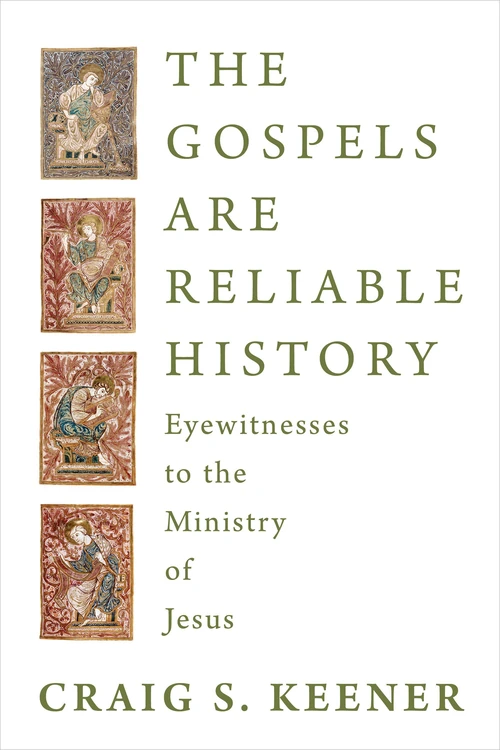
The Gospels Are Reliable History
Eyewitnesses to the Ministry of Jesus
- Apologetics
- Publisher: Eerdmans
- Published: 2026
FritzSearch.com earns a commission on purchases made through Bookshop.org links.
Publisher's Description
Learn what makes the Gospels trustworthy historical sources. For anyone who wonders how much can we really know about the historical Jesus, the answer hinges on a crucial question: can we trust the Synoptic Gospels as historical sources? Scholar Craig S. Keener explores this question using methods accessible to believers and non-believers alike. Setting aside theological questions about divine inspiration, he asks: How do historians evaluate ancient texts’ reliability? What did first-century readers expect from contemporary biographies? And what could Jesus’s followers still remember about him when Matthew, Mark, and Luke were written? Drawing on cutting-edge research in genre and memory studies, Keener demonstrates that the Synoptic Gospels function as ancient biographies—accounts deeply concerned with preserving historical information about a real person. By understanding how ancient biography worked and how early communities transmitted memories, readers gain powerful tools for assessing the reliability of the Gospels of Matthew, Mark, and Luke. Keener previously explored this subject matter in Christobiography, an in-depth, fully documented study for advanced scholars. Now in The Gospels Are Reliable History, he makes this vital research readable and engaging for seminary students, pastors, and general readers. Here, readers will discover why the Synoptic Gospels deserve serious consideration as historical sources—and what that means for learning about Jesus.
Endorsements (3)
“I’m thrilled that we are witnessing a recent spate of books that argue for the historical reliability of the Gospels. Craig Keener’s latest, The Gospels Are Reliable History, summarizes and expands his previous work. This volume is clear and accessible, but his insights are rich. We can be confident that the Gospels are the product of eyewitnesses who lived in the period of living memory of Jesus. I do hope that pastors, students, and lay people will take the time to read this gem.” |”
“I am persuaded that the New Testament Gospels intended to tell their audiences, whether readers or listeners, about Jesus and that is why the evangelists chose to write ‘lives’ of Jesus, or what Keener has called ‘Christobiographies.’ Alongside that persuasion, I am persuaded too that the evangelists intended to communicate living truths to their audiences. This means the Gospels are designed to achieve two goals at once: to bear witness to Jesus and to teach their audiences. And they did so according to the standards of history in their world. No author has done more today to establish the general reliability and trustworthiness of the Gospels than Craig Keener, and this book makes his decades of research available to a more general audience. In a day when many scholars think all we have are ‘memories’ about Jesus, Keener shows that the texts capture in writing certain facts about the life of Jesus, facts that had been told and retold for decades by his earliest followers.”
“Praise for Craig Keener’s previous work on the Gospels:“I have long thought that what we need is to be able to place the Gospels much more precisely within the wide spectrum of ancient biographies. Keener has mastered the literature, primary and secondary—as one would expect.”
See something wrong on this page? Report a problem