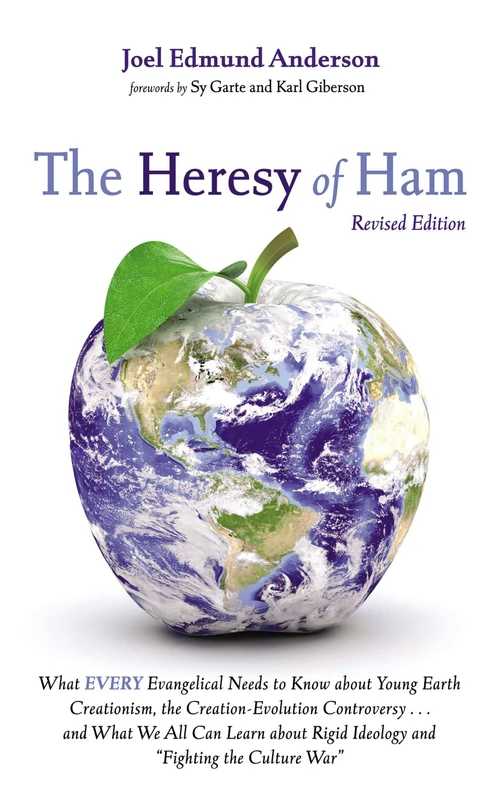
The Heresy of Ham, Revised Edition
What Every Evangelical Needs to Know about Young Earth Creationism, the Creation-Evolution Controversy . . . and What We All Can Learn about Rigid Ideology and “Fighting the Culture War”
- Science & Faith
- Publisher: Resource Publications (Wipf and Stock)
- Published: 2024
FritzSearch.com earns a commission on purchases made through Bookshop.org links.
Publisher's Description
One of the most controversial issues in our society today, especially within Evangelicalism, is that of the creation/evolution debate. Over the past few decades, Fundamentalist apologists like Ken Ham, of the young earth creationist organization Answers in Genesis, have made a career convincing people that the age of the Earth and the historicity of Genesis 1-11 are not just bedrock, fundamental tenets of the Christian faith, but are also crucial fronts in the "culture war." In The Heresy of Ham Joel Edmund Anderson convincingly shows that not only are the YECist claims of Ken Ham unbiblical and unscientific, but they have sowed the seeds of strife and division within countless Christian communities. He should know--he lost his job as a biblical worldview teacher at a small Evangelical school over the issue of YECism. Anderson's ultimate message is simple: regardless of your position regarding evolution or the interpretation of Genesis 1-11, they are not fundamental to the Christian faith and should not be used as battlefronts in the culture war. If you have always had questions about the creation/evolution debate, the claims of YECism, and the way Genesis 1-11 should be interpreted, The Heresy of Ham is a tremendous resource for anyone struggling coming to grips with these issues.
Endorsements (6)
Foreword
“Contemporary evangelicalism is known for its rejection of science, its embrace of a novel and peculiar biblical literalism, and its conviction that issues like evolution, the Big Bang, and the age of the earth are hills to die on. Joel Anderson exposes the tragic heresy that has gripped misguided leaders like Ken Ham, as he creates discord within the Church by insist-ing that it remain mired in nineteenth century debates.”
“Given the title alone, one might reasonably assume the mission is to ex-pose the duplicity of a single corrupt leader. But Anderson’s aim is not ultimately Ken Ham. Rather, the target is a false gospel, wrapped in the guise of biblical purity, for which Ham serves as a high priest. Anderson brings to light critical observations that underlie Ham’s departure from the genuine gospel message. The sequence of steps from the narrow path starts with a dismissal of the writings of early Church fathers, many of whom—long before supposed challenges from science— did not read the first chapters of Genesis in a literalistic fashion. In the place of Church history, Ham and company look instead to the fathers of the Enlightenment and the Scientific Revolution. With science accepted as the arbiter of truth, the Bible is made the servant, forced to fit within a modernized interpretational framework that would have baffled Moses. The final step, with knee bent to the throne of science, is to declare a literal reading of Genesis 1 as foundational to true gospel. Anderson does the Church a great service by exposing not only the doctrinal trauma of this path, but the spiritual carnage and broken people Ham’s heresy has left in its wake.”
“Joel Anderson urges American evangelicals to beware of Ken Ham’s brand of Young Earth creationism, which has gained a foothold in numerous evangelical communities. Anderson contends that Ham’s embattled approach to Genesis and Darwinism is a veritable font of falsehoods, which he exposes ably throughout the book. Worse, however is Ham’s constant admonition to unwitting audiences that anyone who rejects his approach is rejecting the Gospel itself. Anderson charges this threat is not merely preposterous in the light of Scripture, Church tradition, and science. It makes Ham’s articulation of Scripture and science—ironically enough—count as a modern Christian heresy in the historical sense of that term. To make this case against Ham’s creationism, Anderson employs sound scholarship and argumentation, which he presents to non-experts in a non-technical, down-to-earth, sometimes humorous, and always readable style. The book provides such readers with an opportunity to ignore Ham’s blustering threats and to see his approach as the malignant aberration—heresy—that it is. More positively, though, if one is willing to expend the time and effort, it opens a path that leads to a Christian perspective on Genesis and Darwinian science that both enhances personal faith strengthens the credibility of Christianity in society.”
“Neither a trained or practiced scientist or theologian, Ken Ham has come to be the authority figure for too many Christians on questions of science and biblical interpretation. But is his status as a leader justified? Anderson probes the fundamental assumptions of Ham’s scientific claims and theology and finds more than a few weak beams. Instead, he finds a termite-ridden scaffold that would fall under its own weight if his followers took the time to examine Ham’s claims. Heresy or not, I will leave the reader to judge; but Anderson offers a number of insights that should be carefully considered by anyone who has put their faith in Ken Ham.”
“The creation/evolution debate is still very controversial in many circles, especially within evangelicalism. Anderson does a fine job of unpacking this and offers a number of insights that merit serious consideration. Highly recommended.”
See something wrong on this page? Report a problem