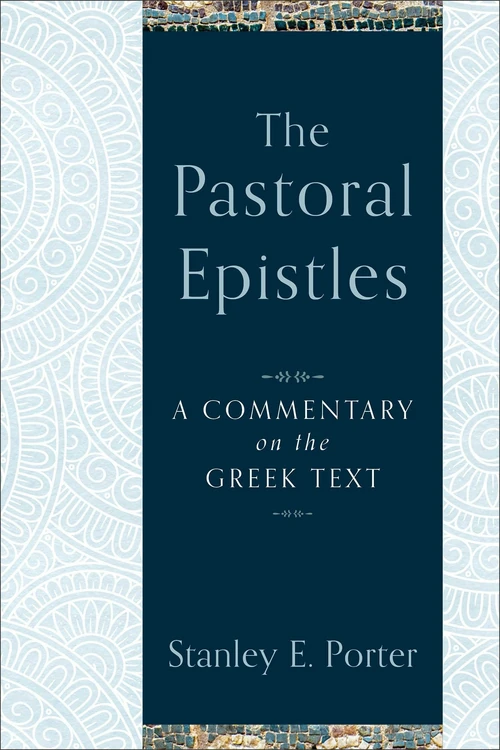
The Pastoral Epistles
- Biblical Studies & Commentaries
- Publisher: Baker Publishing Group
- Published: 2023
FritzSearch.com earns a commission on purchases made through Bookshop.org links.
Publisher's Description
Leading New Testament scholar Stanley Porter offers a comprehensive commentary on the Pastoral Epistles that features rigorous biblical scholarship and emphasizes Greek language and linguistics. This book breaks new ground in its interpretation of these controversial letters by focusing on the Greek text and utilizing a linguistically informed exegetical method that draws on various elements in contemporary language study. Porter pays attention to the overall argument of the Pastoral Epistles while also analyzing word meanings and grammatical structures to tease out the textual meaning. Porter addresses major exegetical issues that arise in numerous highly disputed passages and--while attentive to the history of scholarship on First Timothy, Second Timothy, and Titus--often takes untraditional or innovative positions to blaze a new path forward rather than adopt settled answers. This commentary will appeal to professors, students, and scholars of the New Testament.
Endorsements (6)
“Porter’s commentary on the Pastoral Epistles is one of the most, if not the most, detailed grammatical commentaries on the Greek text. This commentary exhibits Porter’s signature approach to Systemic Functional Linguistics and offers a plethora of new insights for scholarly discussion.”
“Porter writes a different kind of commentary for the Pastoral Epistles, one devoted to an accessible linguistic interpretation of the Greek that helps the reader understand the language of the texts and their situational context. While focusing on insights at the clause level, he also sheds new light by bringing linguistic theory and the data of the texts to bear on the critical issues and the notorious interpretive problems of these controversial and intriguing letters.”
“This is a much-needed book on a contentious group of writings. Porter sheds fresh light on the Pastoral Epistles and the issues surrounding them, especially authorship, by applying a consistent and rigorous linguistic model (Systemic Functional Linguistics) and placing emphasis where it belongs, on the Greek text. No one will want to study these books without recourse to Porter’s meticulous, judicious, and thought-provoking work. Get this book, and refer to it often.”
“This is not just one commentary among many but a unique commentary on the Greek text of the Pastoral Letters. It is intensive and detailed (clause by clause, not word for word, explaining the meanings in context), consistent (based on the linguistic method, Formal Systemic Functional Grammar, explained in the prolegomenon), thorough and encyclopedic (discussing the opinions of other commentators), and extensive (about 1,000 pages). Its language is accessible to the average reader, avoiding technicalities as much as possible. This is a commentary full of original interpretations that presents a new and comprehensive reading of the Pastoral Letters.”
“This is the most thorough commentary in English since the 1999 commentary by Marshall. The introduction is itself a reason to buy this commentary. Porter’s vast knowledge of linguistics and primary and secondary sources is on display in this magnificent commentary, which I suspect will become the standard for the exegesis of the Greek text.”
“If Mount Rushmore honored great and recent English-language commentaries on the Pastorals, alongside the works of I. Howard Marshall, Philip Towner, and Gerald Bray would now appear this offering by Stanley E. Porter. Through rigorous application of Formal Systemic Functional Grammar, Porter sets forth a reading that will provoke and inform constructive discussion for years to come, not least because of conclusive arguments advanced for Pauline authorship.”
See something wrong on this page? Report a problem