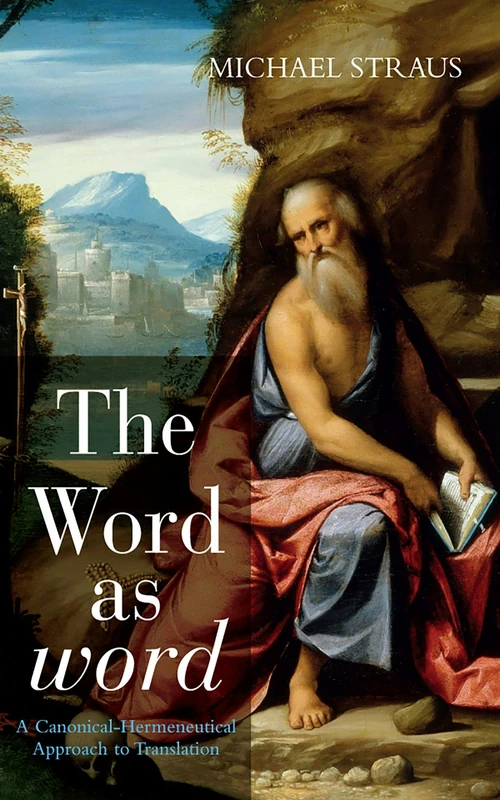
The Word as word
A Canonical-Hermeneutical Approach to Translation
- Biblical Studies & Commentaries
- Publisher: Pickwick Publications (Wipf and Stock)
- Published: 2024
FritzSearch.com earns a commission on purchases made through Bookshop.org links.
Publisher's Description
This book provides an original translation methodology applicable to the New Testament, one that remains rooted in the literal Greek; considers its paleographic and philological characteristics as well as its socio-historical context; understands the text as part of a canonical whole; reflects its reception history in church doctrine and liturgy; accounts for "classical" formulations of its translation-tradition; yet speaks with contemporary literary style. In developing a new methodology, the book appropriates ancient and modern insights into the relationship of thought and language not previously considered in the context of translation. Further, the book is premised on the understanding that Scripture is the divinely communicated Word of God made incarnationally present in the words of the Bible. As the viva vox evangelii, biblical texts thus have ongoing effects in the continuum of church history and tradition. The book argues that contemporary translators of the Bible should therefore be aware of their own situatedness in and shaping by this continuity of linguistic and cultural transmission. As such, the book provides a pathway to translating the Scriptures in such a way as to capture, recapitulate, and incorporate the living sweep of the timeless Word in words that cross time.
Endorsements (5)
“Almost everyone is interested in the different translations of Scripture. Michael Straus’ The Word as word provides a stimulating and penetrating investigation into the art of translation through a canonical-hermeneutical approach. This book is important not only for exegesis, but for any translator of the New Testament. The translation of Colossians demonstrates the importance of translation on interpretation through history and tradition. Readers will be delighted by the history of English translations going back to Wycliffe.”
“The Word as word is a gift: from an experienced translator of the New Testament comes a rich consideration of the art of translating Holy Scripture. The labor of and reflection upon the translation of ancient texts is often separated by specialization. In The Word as word, Michael Straus offers a rare and needed combination of philological and contextual precision, historical and theological awareness, and humane and pastoral sensitivity. Translation, as The Word as word explores it, lives with and moves from ancient words that have and continue to announce the Word.”
“Written with verve and élan, The Word as word challenges us to rethink the assumptions about language, culture, and revelation implicit in different approaches to biblical translation. Michael Straus sets forth a bold vision for Scripture translation that takes seriously the effective history of the text in tradition and the life of the church. The result is a provocative and important contribution to New Testament studies.”
“I heartily endorse Michael Straus’ book as a rare reflection in translation studies. As a translation theorist, Straus takes full account of the apostles’ and church fathers’ concept of the inspired word (including the Trinity). In a clearly structured sequence, he offers different perspectives on the range of other translation approaches, in a spirit of humility and immersive understanding. The result is a greater appreciation of how form, register, and even the use in later church tradition of theological language may be employed in translation, all without falling into the pit of ‘translationese.’”
“What is the relationship between the Word of God living, Jesus Christ the Incarnate Son of God, and the Word of God written, the message which authoritatively proclaims him to a lost world? In what combination do the Holy Scriptures have both divine and human attributes as the living Word of God to which they uniquely witness, including the supernatural power to inspire its readers? Should the living Word’s use of the written word in shaping the ongoing life of the Church effect the Church’s subsequent understanding of it? In short, as a book of the Church, both as its product and as its source, should the Bible be read with the eyes of faith, as that faith has developed through the centuries? Or should the Bible be read “like other books . . . without reference to the adaptations of the Fathers or Divines; and without regard to a priori notions about its nature and origin,” as Benjamin Jowett urged in Essays and Reviews (1860)? Such questions have dominated biblical hermeneutics ever since Jowett’s time. Rarely, however, have such penetrating queries be made of the related task of biblical translation. Should the translator simply seek to recapture the initial exchange between the text in its original language and its first readers, like any other ancient text? Or should the translator recognize the impact of a sacred text on the unfolding linguistic contexts in which the text has been read and which the text has also shaped over th centuries? Moreover, should a translator weigh the importance of how prior translation have shaped the experiences of readers and, therefore, also their expectations for new versions? In The Word as word, Michael Straus grasps the nettle of these thorny issues firmly in favor of the latter. Himself a gifted translator of the New Testament, Straus assesses with much academic learning and a practitioner’s insight both the strengths and weaknesses of the three main current approaches before offering his own canonical hermeneutical theory of translation. Future editions of the Bible and their readers will no doubt owe a great debt to Straus’ contribution to this important field.”
See something wrong on this page? Report a problem