Rubén Rosario Rodríguez
Biography
Rubén Rosario Rodríguez wrote Dogmatics after Babel, Theological Fragments, and Calvin for the World.
Bios generated by automated processes. · Report a problem
A Theology for the Twenty-First Century
Theology
“Cynically, I had assumed that institutional Christianity was in decline, that liberalism was dead, and that even evangelicalism had fractured beyond repair. Worse, I assumed that the age of systematic theologies—those comprehensive, rational, and internally coherent accounts of the Christian faith one associated with such luminaries as Aquinas, Calvin, and Barth—had come and gone. Thankfully, Douglas Ottati has proven me wrong on both counts by developing a systematic theology that runs the gamut of Christian doctrine, from creation to redemption, organized in seventy christologically centered propositions. What Ottati delivers in this massive yet approachable volume is the best that Christian humanism has to offer: a political theology that stands as a much-needed alternative to the narrow sectarianism of the so-called Benedict Option.”

Arts & Literature
“After Eden is a collection of poems—the term seems somehow inadequate, artificial, and constricting—springing from lo cotidiano (‘the day-to-day’) of Latino/a life in these United States. As such they serve as a cry of despair, stubbornly clinging to hope while embodying the most challenging form of love: solidarity. . . . I know a prophetic voice when I hear it. Let those with ears to hear listen.”
Ethics, Culture & Social Issues
“Since the evangelical revolution of the 1970s and 1980s, evangelicalism has given the impression that it is immune to the decline plaguing mainline Protestantism. That is, until now. As David Gushee’s insightful analysis of the current post-evangelical moment suggests, US evangelicalism squandered its opportunity, and now people—especially young people—are leaving evangelical Christianity. As Gushee demonstrates, evangelicalism’s wounds are mostly self-inflicted, originating in the move by straight white men to perpetuate structures that reinforce their power and dominance over the life of the church. Gushee is driven by a profound need to address the pastoral concerns of this growing post-evangelical movement and herein offers a combination manifesto, love letter, and game plan for fellow #exvangelicals. The rest of the church would do well to heed his words too. Gushee’s spiritual inventory of this movement and his articulation of a post-evangelical theological framework serve as a road map for renewal for a fragmented and moribund first-world Christianity.”
Ethics, Culture & Social Issues
“Luke Bretherton’s highly original and challenging book cuts across the dominant polarities characterizing political theology—religious/secular, church/state, and private/public—in order to challenge Christianity to embrace the political dimensions of its very public faith without reducing theology to pragmatic political considerations. The book’s unconventional yet innovative approach rests in its ability to engage a multiplicity of theological and political traditions without limiting itself to any one theoretical framework, thereby allowing certain pressing existential questions to guide the conversation and in the process remind the reader that God-talk and political talk are, and have always been, mutually intertwined. In other words, Bretherton’s conception of political theology brings together the prophetic and corporate dimensions of the Christian faith for the sake of a shared common good in our increasingly pluralist context.”
Defending Democracy from Its Christian Enemies
Ethics, Culture & Social Issues
“The most persistent myth in US history is the notion that we are a Christian nation. Without denigrating the contributions of the Christian religion to the development of American society, David Gushee critiques idolatrous forms of authoritarian reactionary Christianity that actively undermine democratic institutions, which in his analysis reflects a global trend toward populist antidemocratic politics. In place of religious totalitarianism Gushee offers a Christian defense of democracy, applicable mutatis mutandis in other political and religious contexts, that aims to restore the American idea once eloquently described by Alexis de Toqueville as a ‘beacon on a hill.’”
Theology
“As a Latino pastor and theologian in the Presbyterian church, I am often asked, 'Why are you Presbyterian?' This wonderful volume offers several excellent responses to the naysayers and critics. It also reminds those of us in the Reformed tradition why we stay. The Reformed tradition cannot be reduced to any one confession or creed but rather encompasses an ecumenical and global family of churches united by certain theological themes ranging from faith in the benevolent sovereignty of God to the presence of the Holy Spirit in the church's compassionate ministries, all grounded in the Word of God as revealed in Christ. In other words, there are many branches in the Reformed genealogical tree, and they reach far and wide because, as Reformed believers, we are committed to the Nicene Creed's vision of one, holy, catholic, and apostolic church.”
Ethics, Culture & Social Issues
“Christian ethicist David Gushee's latest, a collection of essays written for a variety of audiences, yet exhibiting a refreshing unity of perspective, stands as a model for what an engaged public theology from a confessional perspective ought to look like. . . . All scholars should aspire for this level of integrity and authenticity in their professional work.”
Ethics, Culture & Social Issues
“This highly revised second edition of the now-seminal Kingdom Ethics improves what was already a practically perfect primer on Christian ethics for laypersons, pastors, and theologians. . . . Gushee and Stassen present an intelligent and comprehensive introduction to the ‘doing’ of Christian ethics grounded in their lived faith, yet their work remains approachable and valuable to those who do not share that faith.”
Ethics, Culture & Social Issues
“This collection of essays edited by Abimbola A. Adelakun brings together insights from performance theory, theology, and ethics to articulate a conceptual framework that shifts attention away from the individual moral agent and unto the structures that hinder human flourishing. This corrective to the widespread narcissism that often characterizes public debate of social justice issues cultivates public righteousness over against self-righteousness. By taking human suffering seriously the various authors transform this work into something beyond utopian wish fulfillment—and deserving of a wide readership beyond the academy.”
Biblical Studies & Commentaries
Foreword
“In Reasonable Doubt: Learning to Dwell in Biblical Ambivalence and Paradox, Hanz Gutierrez Salazar gives the religious believer and the non-religious observer a hermeneutical framework for engaging the Bible not as a dead letter forever stuck in the past, nor as an authoritarian moral compass from which there is no deviation, but as an encounter with the Other circumscribed by this simple paradox: a text written, preserved, and disseminated by human acts is also Word of God. The author concludes, ‘Truth is only in the search for truth, and the engine of that search is reasonable doubt.’”
Theology
“This book provides an overview and analysis of the now classic texts of feminist Christian theology through the lens of rhetorical theory in order to remove the discourse from the staid realm of dogmatic theology and into the critical moral analysis of power relations and existing social realities. To that end, Baard centers the conversation on the feminist rejection of traditional “sin-talk” without undermining the seriousness of sin—especially dehumanizing and exploitative social sin—in an effort to expose, reject, and transcend the rhetorical distortion that perpetuates patriarchal structures built on the domination and control of the many by the few, the female by the male, and the poor by the rich. In its stead, the author offers a hopeful constructive vision of feminist “sin-talk” that preserves the socially transformative power of the biblical prophetic tradition while also affirming feminist “grace-talk” through a soteriocentric and theocentric engagement of the foundational (for confessing Christians) Christ event.”
Biblical Studies & Commentaries
“In The Hermeneutical Spirit II: Migrations, Diasporas, and Cultures After Pentecost, Amos Yong offers an interpretation of Luke-Acts, the Catholic Epistles, and the book of Revelation through two distinct yet profoundly interrelated lenses: the Christian community after-Pentecost and contemporary believers’ experience of migration and diaspora. For Yong, biblical hermeneutics entails a delicate dance between tradition, Scripture, and culture, with all three necessary for a faithful reading of the Word. In other words, Yong demands that the Bible not be read as a dead letter, useful for reconstructing the historical past, but as the Living Word of God that values our cultural particularities while transcending confessional cul-de-sacs.”
Theology
“Theologizing in Black by Celucien Joseph brings the voices of Africa and the African Diaspora to center stage while avoiding the US-centric bias of African Diaspora studies by locating distinctly US voices like James H. Cone in global context. Joseph challenges Africana studies and black liberation theology to engage theological writings in languages other than English, thereby providing a much-needed corrective to the Western and Eurocentric cultural hegemony within academic discourse.”
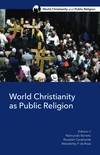
World Christianity as Public Religion
Theology
“The product of a cooperative effort between Princeton Theological Seminary and the Faculdade Unida de Vitoria, this volume honors and builds upon the legacy of ecumenical partnerships associated with John Alexander Mackay (1889-1983). Yet the global church represented in these ten chapters differs in diversity and missional focus from the nineteenth-century monocultural missionary paradigm. In its place is offered a lively interculturality representing various local theologies, each one reflective of different cultural and political contexts that incarnate the body of Christ in diverse indigenous settings. Despite this diversity, the resulting mosaic remains united in questioning economic injustice in the public square by seeking answers for certain persistent realities like migration, religious pluralism, urbanization, environmental degradation, racism, and gender inequity in successive volumes. This impressive first volume sets the stage by presenting Christianity as a political player on the global stage, no longer as the declining church of the First World, but as the thriving church of the Global South.”
NOTE: Only includes books currently in our catalog; not necessarily a complete list.
See something wrong on this page? Report a problem