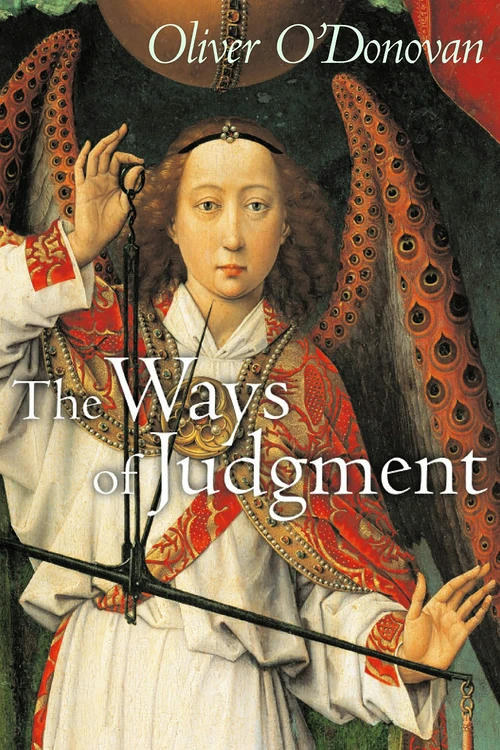
The Ways of Judgement
- Ethics, Culture & Social Issues
- Publisher: Eerdmans Publishing
- Published: 2008
FritzSearch.com earns a commission on purchases made through Bookshop.org links.
Publisher's Description
In this probing book Oliver O'Donovan extends the exploration into the correspondence between theology and politics that he began in The Desire of the Nations. While that earlier work took as its starting point the biblical proclamation of God's authority, The Ways of Judgment approaches political theology from the political side. Responsive to developments such as the uncertain role of the United Nations after the Cold War and the expansion of the European Union, O'Donovan also draws on the extensive tradition of Christian political thought and a range of contemporary theologians. Rather than supposing, as does some political theology, that the right political orientations are well understood and that theological beliefs should be renegotiated to fit them, O'Donovan considers contemporary social and political realities to be impenetrably obscure and elusive. Finding the gospel proclamation luminous by contrast, O'Donovan sheds light from the Christian faith upon the intricate challenge of seeking the good in late-modern Western society. Pursuing his analysis in three movements, O'Donovan first considers the paradigmatic political act, the act of judgment, and then takes up the question of forming political institutions through representation. Finally, he tackles the opposition between political institutions and the church, provocatively investigating how Christians can be the community instructed by Jesus to "judge not."
Endorsements (4)
“The Ways of Judgment is political theology as it used to be done, and as it should not be attempted at home. In a no-nonsense way, we are simply told what certain concepts mean, and instructed in what the proper shape of political order ought to be. All this without extensive qualification, justification, commentary on the literature, or academic caution. . . It is meant as a high compliment to say that The Ways of Judgment is a deeply and astonishingly unfashionable book. . . A glory of this book is that everyone — liberals, conservatives, communitarians, socialists, libertarians — will likely be offended by something.”
“No one should accuse Oliver O'Donovan of tackling easy topics. . . In rich dialogue with both political thinkers and the Christian tradition, O'Donovan addresses many of the traditional topics of a course in political theory: justice, equality, authority, legitimacy, and so on. . . At every stage, O'Donovan offers challenging conclusions.”
“In this sequel to his Desire of the Nations, Oliver O'Donovan displays a wisdom we have come to expect from him. He throws light on political conceptions from the final vantage point of Christian convictions resident in the creeds. A powerful, carefully considered work that unforgettably reconceives how we may live in late-modern Western society.”
“Oliver O'Donovan presents us here with a thorough and reflective book on the essence of politics and its institutions. This is not merely another political science book, however, but an intellectual history of the very theological and philosophical ideas out of which our modern political rhetoric grew, including that system that sought to understand itself without revelation. Chesterton once remarked that the very purpose of the mind is ultimately “to judge; in many ways, O'Donovan rightly says, politics is a continual act of judgment, an effort to distinguish what is right from what is wrong. O'Donovan carefully shows us what this means in the realm of politics and what are its transcendent implications.”
See something wrong on this page? Report a problem