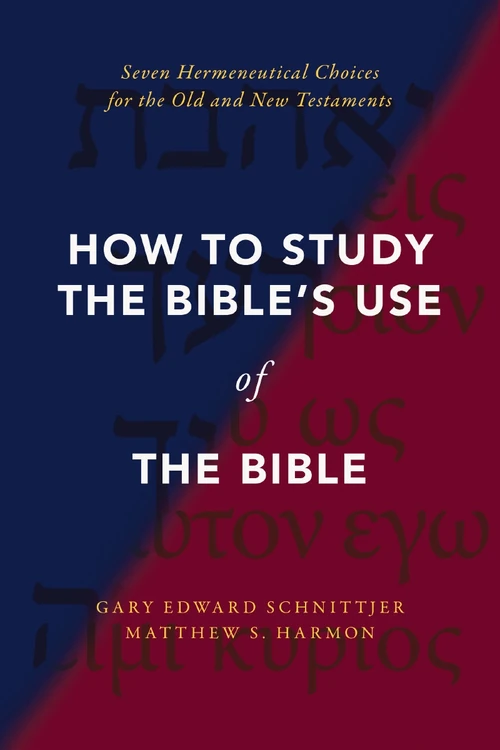
How to Study the Bible's Use of the Bible
Seven Hermeneutical Choices for the Old and New Testaments
- Biblical Studies & Commentaries
- Publisher: Zondervan Academic (Zondervan)
- Published: 2024
FritzSearch.com earns a commission on purchases made through Bookshop.org links.
Publisher's Description
How to Study the Bible's Use of the Bible: Seven Hermeneutical Choices for the Old and New Testaments by Gary Edward Schnittjer and Matthew S. Harmon is an essential resource aimed at teaching a hermeneutic for understanding the Bible's use of the Bible. Intended for students of both testaments, the book's innovative approach demonstrates how the Old Testament use of Scripture provides resources for the New Testament authors' use of Scripture. The authors provide students with a clear approach to handling the Bible's use of itself through seven key hermeneutical choices organized into individual chapters. Each chapter introduces a hermeneutical choice and then provides several examples of the Old Testament use of Old Testament and the New Testament use of Old Testament. The plentiful examples model for students the need to ground hermeneutics in biblical evidence and provide insight into understanding why the Bible's use of the Bible is important.
Endorsements (15)
“How to Study the Bible’s Use of the Bible offers readers a front row seat to key developments in the study of Scripture’s engagement with Scripture. Schnittjer and Harmon help readers navigate choices that that confront readers of the Bible's interconnections. Jam-packed chapters trace the implications of a guiding claim that the New Testament’s use of the Old follows interpretive practices that already matured within the Old Testament.”
“Scripture interprets Scripture” is an age-old Protestant hermeneutical rule of thumb; the NT use of the OT is a newer, and burgeoning, academic field. Schnittjer and Harmon argue compellingly that undergirding both notions is inner-biblical exegesis, specifically, the OT use of the OT, a relatively neglected topic. They also present a strong case for viewing the OT use of earlier Scripture as a primary resource for the NT use of the OT—and for Jesus’s own biblical interpretation. This was, for me, an eye-opening examination of the hermeneutical choices every student must make to understand the Bible’s use of the Bible, a matter of no little theological import for all who profess biblical authority.”
“This incisive study directs any student of the Bible to hone and fine-tune their methodology when considering the relationship between the Old and New Testaments. Schnittjer and Harmon call for a connected approach that pays as much attention to the Old Testament’s use of itself as it does to the New Testament’s use of its existing scripture. They weave their way through a myriad of scholarly suggestions to present a strong toolbox of seven hermeneutical choices that the careful student can select and apply to biblical texts, many of which form case studies in this book. Frequently asked questions and study questions accompany this invaluable guide to a Christian appreciation of the subtleties of the progressive revelation of scripture in its plain sense, a scripture that is God-given and God-inspired, that is thoroughly biblical in its exegetical tendencies, and that is ultimately fulfilled in the New Testament’s messianic exegesis.”
Professor. Katharine Dell
“Schnittjer and Harmon have provided a valuable resource on the Bible’s use of the Bible. They expand the discussion past the New Testament’s use of the Old to include the use of the Old in the Old. They don’t try to force one system but allow the text to drive their conclusions. This allows for a nuanced and non-reactive survey of current debates that will be a help to pastors, students, and scholars for many years to come.”
“Those who have appreciated Gary Schnittjer’s ground-breaking Old Testament Use of Old Testament will welcome this study. Gary has teamed up with New Testament scholar Matthew Harmon to produce a “how to” book outlining a carefully designed method for understanding how the Bible uses the Bible. Right up front the authors state a foundational principle that drives their approach, namely, that the Old Testament’s use of the Old Testament “provides a model and a guide for the use of scripture in the New Testament.” I am impressed with the breadth of their research and the precision of their analyses. Readers will appreciate user-friendly features like case studies and a glossary of definitions for key terms. The book is well-designed for use as a course text, with study questions and a Zondervan link to a variety of pedagogical aids. I heartily recommend it as a text for hermeneutics courses and as an invaluable guide for those trying to navigate this sometimes-bewildering field of study.”
“They have done it again—How to Study the Bible’s Use of the Bible by Gary Schnittjer and Matthew Harmon is a fountain of wisdom for biblical interpretation! Modeled on the exegesis employed within Israel’s own scriptures, this book ably offers an eminently useful workshop for understanding how the Bible’s revelation unfolds organically. How to Study the Bible’s Use of the Bible forms a needed corrective to a variety of hermeneutical errors even while deftly guiding readers into the deep riches and beautiful layers of the biblical canon. This book is a must-have for pastors and Bible students.”
“In the crowded field of books on the NT use of the OT, this volume by Matt Harmon and Gary Schnittjer stands out by extending the issue to include the OT use of the OT. This added dimension enhances our appreciation of the unity of biblical revelation. Harmon and Schnittjer are especially focused on providing students of the Bible a method to apply to the issue. Many “case studies” flesh out this approach to methodology.”
“In this exciting new book by two of the great masters of biblical intertextuality studies, Gary Edward Schnittjer and Matthew S. Harmon set out for students and scholars alike both the why and the how of the discipline. The rigor and clarity of this book is the sort that only emerges after years of meticulous, detailed study. In a field where intertextuality is often located in the eye of the beholder, the authors are to be thanked for opening up the technicalities of the discipline in such an accessible way. Through methodological discussion and worked examples, they have, in effect, provided a roadmap for the next generation of biblical scholars. This is a book I will return to again and again.”
“This book addresses an important and neglected area of intertextual studies. Providing a clear introduction to and explanation of key hermeneutical choices that need to be considered by readers of the Bible as a unified text with progressive revelation, Schnittjer and Harmon show how interpretive decisions directly impact exegetical findings. Readers will be challenged to think critically about issues, reflect on their implicit assumptions, and recognise the deep complexity of this task. Filled with model examples, study aids, discussion questions, and an expansive glossary, this work is ideal as a course text and for those interested in this subject regardless of their knowledge of ancient languages.”
“Schnittjer and Harmon have done a monumental service to students of Scripture in How to Study the Bible’s Use of the Bible. Relying on exhaustive research and detailed case studies, the authors walk the reader through the often-imposing process of determining the use of Scripture within Scripture. The result is not just a practical handbook, but a thorough overview of the state of the question and a wealth of exegetical insight on particular texts. For anyone interested in biblical exegesis, this book is essential.”
“Most Christians know that the OT relates to the NT in some way—but how? Schnittjer and Harmon provide seven interpretive choices that serve as a useful guide for the student of Scripture. Most importantly, they begin with how the OT uses the OT, before looking at how the NT uses the OT. The overall effect is to show the organic progress of revelation. Whether one agrees with everything the authors propose in their hermeneutical approach, reading this book will stimulate further thinking and discussion in the whole area of inner-biblical interpretation.”
“This book provides students with an accessible entry point into seven important conversations in how to understand the ways that biblical authors read Scripture. Drawing upon and then distilling key secondary literature, Schnittjer and Harmon offer an indispensable resource for students and pastors interested in the topic.”
“Gary Edward Schnittjer’s and Matthew S. Harmon’s project, How to Study the Bible’s Use of the Bible, is a treat. Rarely does a project glean from the OT’s use of the OT and apply those insights into the apostles’ use of the OT. They evaluate contemporary approaches, offer a way forward, and wisely articulate seven hermeneutical choices for the reader.”
“Schnittjer’s and Harmon’s book contributes to the exciting, complex, and often debated field of hermeneutics. Schnittjer and Harmon write in clear prose, provide straightforward aims, give insightful case studies, offer thought-provoking study questions, communicate with an accessible style, and offer an informative glossary of key terms. Even when readers disagree with their exegesis, examples, arguments, method, analysis, or conclusions, students, scholars, and others interested in hermeneutics will still learn much about how to study the Bible’s use of the Bible.”
“Can a textbook also advance scholarship? This one does. Schnittjer and Harmon take the exploration of Scripture’s use of Scripture to the next level by identifying weak areas and problematic approaches in previous scholarship, especially the widespread neglect of the Old Testament’s use of the Old Testament. I expect to return to this volume again and again. It’s methodologically rigorous, with clear examples in every chapter. The book will benefit advanced students who are ready to build on the basic foundation of their Hermeneutics 101 as well as career scholars who want to keep growing.”
See something wrong on this page? Report a problem