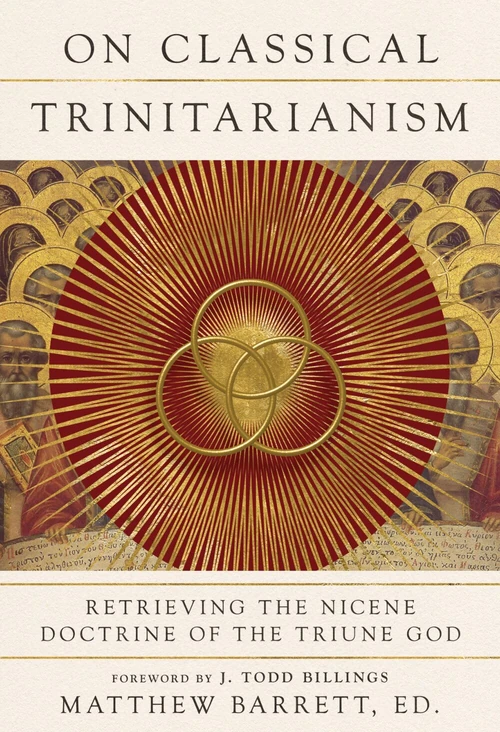
On Classical Trinitarianism
Retrieving the Nicene Doctrine of the Triune God
- Theology
- Publisher: IVP Academic (InterVarsity Press)
- Published: 2024
FritzSearch.com earns a commission on purchases made through Bookshop.org links.
Publisher's Description
The Gospel Coalition Book Awards Winner – Theological Studies Modern theology claimed that it ignited a renaissance in trinitarian theology. Really, it has been a renaissance in social trinitarianism. Classical commitments like divine simplicity have been jettisoned, the three persons have been redefined as three centers of consciousness and will, and modern agendas in politics, gender, and ecclesiology determine the terms of the discussion. Contemporary trinitarian theology has followed the spirit of this trajectory, rejecting doctrines like eternal generation which were once a hallmark of Nicene orthodoxy and reintroducing subordinationism into the Trinity. Motivated by the longstanding need to retrieve the classical doctrine of the Trinity, theologian Matthew Barrett brings together Protestant, Roman Catholic, and Eastern Orthodox scholars to intervene in the conversation. With over forty contributions, this ecumenical volume resurrects the enduring legacy of Nicene orthodoxy, providing a theological introduction that listens with humility to the Great Tradition. In On Classical Trinitarianism, you find contributions from a wide range of scholars, including: Katherin Rogers Andrew Louth Gilles Emery Steven Duby Gavin Ortlund Adonis Vidu Carl Trueman Matthew Levering Fred Sanders Scott Swain Karen Kilby Amy Peeler Thomas Joseph White and more! The distinct yet united voices of On Classical Trinitarianism summon the next generation to move past modern revisionism for the sake of renewing classical trinitarian theology today. Together, they demonstrate that Nicene orthodoxy can endure in the modern world and unite the church catholic.
Endorsements (11)
“Evangelical retrieval of classical trinitarianism is a vital project. This massive resource represents various approaches and levels of polemical intensity along with a core set of convictions. I can't believe I read the whole thing! But its many fine essays convey valuable insights, sound some necessary alarms, and pose enduring questions.”
“This is a marvelous primer on the church's historic understanding of the Trinity. Its topics and authors have been very well chosen. May God use it to renew our discipleship today, growing everyone who reads it in the knowledge and love of God.”
“One will be hard-pressed to find a more comprehensive explanation of trinitarian doctrine than this collection of essays. Matthew Barrett has assembled a prestigious team of scholars to explain what the Trinity is and why it still matters. On Classical Trinitarianism is an outstanding achievement in modern scholarship on the Christian doctrine of God.”
“With a wide variety of historical, dogmatic, and critical essays, this book invites and equips its readers to join the revival of classical trinitarian theism.”
“Like a meteor on the scene of contemporary theology, Matthew Barrett's edited volume, On Classical Trinitarianism, makes a big impression. Physically, it is a massive book, full of hefty articles by many of the world's leading theologians. Intellectually, it is an equally massive response to recent innovations in the doctrine of God—from social trinitarianism to eternal functional subordinationism—in favor of orthodox trinitarian theology and its attendant doctrine of divine simplicity. It is also a reminder of the importance of thinking with ecclesial tradition and of the corresponding dangers, when talking about the profoundest of mysteries, of trying to think about God apart from it—lest even Christians forget that they are trinitarian monotheists and that God is simply Father, Son, and Spirit.”
“On Classical Trinitarianism is the most significant text published this year, if not this century. While a trinitarian renaissance certainly began in the twentieth century, distinctly modern and postmodern echoes of ancient heresies arose to challenge believers who seek to restate with integrity for our day 'the faith that was once for all delivered to the saints' (Jude 1:3). The scholars herein, wisely gathered by Matthew Barrett, not only represent a wide spectrum of Christian tradition but offer deep studies into orthodoxy's exegetical and historical basis and helpfully describe the contours of this indispensable dogma. Renewing our understanding of God the Trinity so that we may worship him truly and confess him properly will be the best way to celebrate the signal accomplishment of Nicaea. So, please, take up and read!”
“On Classical Trinitarianism is a breathtaking accomplishment. An astonishing array of contributions maps the field of trinitarian theology—historical, dogmatic, and polemical. The forty chapters, written by prominent theologians from each of three major branches of the church, are a major refutation of the so-called revival of the Trinity in twentieth-century theology. This publication is a serious, in-depth reassertion of classical Nicene theology over against the recent onslaught of social trinitarianism with its rationally comprehensible and compositional (and, often, subordinationist) view of the Trinity. Anyone attempting a return to the social trinitarianism of the previous century will have to reckon with Matthew Barrett's major accomplishment in this volume.”
“Matthew Barrett's remarkable collection shows evangelicalism getting its doctrinal house in order, but its importance also lies well outside evangelicalism as an ecumenical collection: in authorship, mood, method, and—most of all—common confession of the Nicene faith. Everything we could wish for is here in abundance: attention to the Bible, history, doctrine, texts, figures, and vocabulary. Like some collection of glorious music or poetry offered on the anniversary of a beloved monarch as a 'garland,' On Classical Trinitarianism is a magnificent garland in honor of the Nicene Creed after seventeen centuries.”
“The Trinity gives coherence to Christian faith and life. While multiauthor volumes often lack coherence, a beautifully biblical and classically catholic vision of the Trinity draws these contributors together. Presenting a positive, and overwhelmingly persuasive, depiction of ideas such as divine simplicity, processions, missions, and appropriations, this book has potential to change permanently how many modern Christians think about the Trinity. Though it is likely naive to hope that this will be the case, this material should kill and bury any notion of subordination in the Trinity, showing that such dead ideas are incompatible with the living faith of the church. A lot remains at stake in trinitarian theology, and this volume goes along way toward illustrating why and how.”
“This admirable book makes the rediscovery of trinitarian theology truly exciting. After showing the struggles of the early Fathers for an adequate terminology to express the mystery of the Trinity, it carefully traces the history of the doctrine. The book also provides a healthy corrective to the many ways that contemporary theology has strayed from the tradition of Nicaea.”
See something wrong on this page? Report a problem