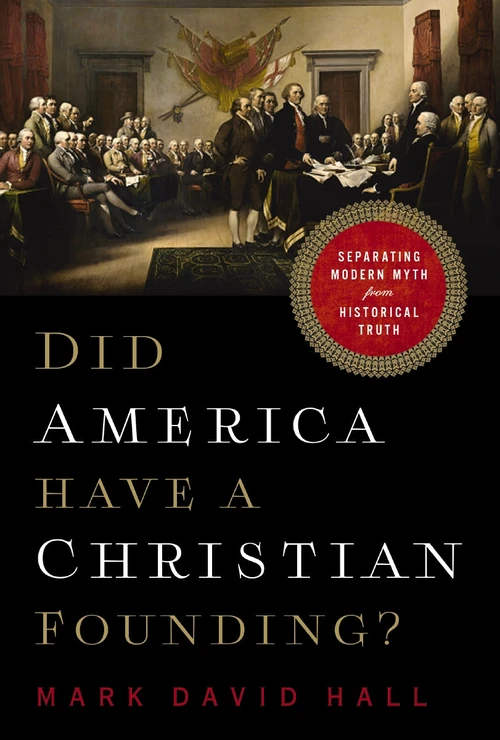
Did America Have a Christian Founding?
Separating Modern Myth from Historical Truth
- Ethics, Culture & Social Issues
- Publisher: Nelson Books (Thomas Nelson)
- Published: 2020
FritzSearch.com earns a commission on purchases made through Bookshop.org links.
Publisher's Description
A distinguished professor debunks the assertion that America's Founders were deists who desired the strict separation of church and state and instead shows that their political ideas were profoundly influenced by their Christian convictions. In 2010, David Mark Hall gave a lecture at the Heritage Foundation entitled "Did America Have a Christian Founding?" His balanced and thoughtful approach to this controversial question caused a sensation. C-SPAN televised his talk, and an essay based on it has been downloaded more than 300,000 times. In this book, Hall expands upon this essay, making the airtight case that America's Founders were not deists. He explains why and how the Founders' views are absolutely relevant today, showing that they did not create a "godless" Constitution; that even Jefferson and Madison did not want a high wall separating church and state; that most Founders believed the government should encourage Christianity; and that they embraced a robust understanding of religious liberty for biblical and theological reasons. This compelling and utterly persuasive book will convince skeptics and equip believers and conservatives to defend the idea that Christian thought was crucial to the nation's founding--and that this benefits all of us, whatever our faith (or lack of faith).
Endorsements (13)
“PRAISE FOR DID AMERICA HAVE A CHRISTIAN FOUNDING? “Mark’s excellent book is so needed. Many do not understand the basics of religious freedom. Mark’s book, though written by an academic, is a great beginning, helping citizens begin to understand the crucial issues of our first freedom.”
“In Did America Have a Christian Founding?, Mark David Hall debunks widespread secularist myths and provides a lively, illuminating account of the role of Christianity in our nation’s founding. Everyone who cares about our nation’s founding can benefit from this valuable and insightful book.”
“Since Justice Hugo Black’s opinion in Everson v. Board of Education (1947), we have been told that a deist ‘wall of separation between church and state’ defined the relationship between government and religion established by the American Founders with the Constitution, including the Bill of Rights. Now Mark David Hall, leading expert on American church-state relations and author of the best biography of Founder Roger Sherman, shows that Black erred, and wildly. The American Revolution was a Christian revolution, the American Founding was a Christian founding, and the religious freedom of the First Amendment is a product of Christian thought at the time of the Revolution. Freedom of religion was intended for people of all faiths, but it was not anti-religious. Hall gives us a bracing corrective to a pernicious myth—and shows us how his conclusions are applicable today.”
“The American republic was not founded in 1787 as a unitary, confessional, Christian state. But it was founded within the context of an overwhelmingly Christian population, and nearly all the Founders adhered to, or were influenced by, Christian moral teachings and practices. Most importantly, the Founders recognized that if their new regime of ordered liberty was to survive and prosper, it must be sustained by the indispensable pillars of religion and morality. Professor Hall’s lucid volume illuminates these often-overlooked influences on the Founders and corrects many modern misconceptions about their political philosophy and achievements.”
“Mark David Hall has provided a decisive, readable, and scholarly answer to the perennially debated question, Did America have a Christian founding? Herein, a distinguished American historian demonstrates far beyond a reasonable doubt that America’s Founders were deeply influenced by the Christian faith. If you have time to read only one book on the subject, this is categorically the one you should choose.”
“After years of reading overstatements from both sides of the Founding debate, I enjoyed Mark David Hall’s calm and thorough analysis. Mind readers and diary extrapolaters may still fight over questions of sincerity and personal faithfulness, faithfulness, but Hall clearly shows what’s most important: that Christian ideas profoundly influenced the Founders, and through them all of us.”
Dr. Marvin Olasky
“In this beautiful book, Mark David Hall fully debunks the pervasive myth that America’s founders were deists. As I turned each page, my smile grew larger to know that here, in a single short book, history was being set aright, in a way that should hush the voices of those who have too long declared that our founders were not really men of faith. As Dr. Hall ably demonstrates, America’s founders were driven by a deep sense of religious conscience, founded in their Christian faith, to establish a new nation conceived in liberty.”
“Carefully researched and skillfully nuanced, Mark David Hall’s Did America Have a Christian Founding? challenges the view that America’s founding was more secular than religious. For those who want to understand the influence of the Bible on the American founding, Hall offers a readable and compelling case for the linkages of Christian faith and American liberty.”
“In his new book, Did America Have a Christian Founding?, Mark David Hall makes the compelling case that the majority of the Founding Fathers were not deists who openly rejected Orthodox Christian doctrines, and who advocated the strict separation of church and state. On the contrary. Hall persuasively argues that—with the exception of Benjamin Franklin, Ethan Allen, and Thomas Paine—the Founders were influenced by Christian ideas, and that even Jefferson and Madison (who have often been portrayed as doctrinaire deists) did not want a high wall separating church and state. He also discusses the Christian faith and views on church-state relations of some of the lesser-known Founders, such as Roger Sherman, James Wilson, and John Witherspoon. While Christianity was not the only significant influence on the thought of America’s Founders, Christianity had a profound influence on the founding generation. The Christian faith of the Founders, beginning with George Washington, influenced and shaped their political beliefs and actions. Hall’s beautifully written and immensely thoughtful new book should be read by anyone interested in the role of religion in the founding of the American Republic. Rich in its insight and analysis, Hall’s book brilliantly illuminates the interplay of American politics and religion during the founding era, and explains how and why the Founders’ ideas are still relevant to our understanding of the role that religion should play in American public life today.”
“In Did America Have a Christian Founding?, Mark Hall grants the modern reader a window into the predominant worldview of our Constitution’s many framers and ratifiers, through dozens of original sources and hundreds of scholarly references. In contrast to the bias-driven mythologies he exposes, Hall leads his readers to reasoned conclusions about historical truth through objective scholarship in the vein of storytelling. He is humble enough to acknowledge legitimate separationist claims, while bold enough to demonstrate how the preponderance of historical evidence begs an affirmative answer to his title question. With many implications for today’s challenges, Did “In this book, Professor Hall powerfully and thoroughly rebuts—claim by claim—the consistently errant assertions by a never-ending stream of prominent and popular commentators who report that the American Founding was a wholly secular and enlightenment affair. His work builds from his impressive thirty-year scholarly corpus on how the American Founding was importantly influenced by Protestant Christian theology and institutions. Here he convincingly shows that the putative hostility of the American Founders to Christianity and their embrace of a secular philosophy is ‘unequivocally false’ for all but a small handful of men and, in most cases, for only part of their lives, often years before or after the Founding period. Hall demonstrates that these claims about a secular founding are consistently made without convincing (or, in some cases, any) supporting evidence, in a manner that prevents the formation of an accurate understanding of America, then and now, to the detriment of all.”
“Professor Hall examines the passionately debated question of whether America had a Christian founding, through the lens of honest scholarship for which he is known and respected. The result is a highly readable book for anyone who seeks a thoughtful and fair-minded evaluation of the Founders’ understanding of Christianity, and its relationship to the national government that they established through the Constitution and made subject to the First Amendment.”
“This is a book we have badly needed for a long time, and Mark David Hall has performed a great public service in writing it. For too long the subject of Christianity’s relationship to the American Founding has been needlessly obscured in a fog of misunderstanding, oversimplification, half-truth, and deliberate misrepresentation. Hall has cut through the fog, producing a work that not only builds on the most careful recent scholarship, but presents its findings in a remarkably accessible and persuasive way. For its clear and penetrating insights into the American past and present alike, this is a book that every thoughtful American needs to read.”
“In this engaging book, Mark David Hall revisits the persistent myth that the American founding was a strictly secular, enlightenment project. Among the questions he investigates are: Were the American founders all deists who framed a godless Constitution? Did the founders erect a high wall of separation between church and state, restricting religion’s role in public life? These are not questions merely of academic interest; rather, as Hall shows, they have immediate implications for law and public policy. His insightful, amply documented conclusions will inform the lay historian and seasoned scholar alike.”
See something wrong on this page? Report a problem